Church Rules on Marriage and Divorce
The Castle of OtrantoChurch Rules on Marriage and Divorce are a legal and religious authority in The Castle of Otranto, not merely a private matter between spouses. They constrain Manfred’s attempt to end his marriage to Hippolita and take Isabella as his wife, while exposing the conflict between his dynastic calculations and the Church’s standards of lawful union. Through Jerome’s resistance and the final supernatural judgment, the narrative makes marriage law part of its wider question of who has a legitimate claim to rule.
Marriage as Dynastic Policy
Manfred’s marriage plans begin as a means of securing succession. He has arranged for his son Conrad to marry Isabella, daughter of the Marquis of Vicenza, and Isabella has been placed in his custody pending the ceremony. Manfred’s haste alarms his household and subjects, who suspect that he fears an old prophecy concerning the transfer of Otranto. After Conrad’s death, Manfred redirects the proposed match: he tells Isabella that he will marry her himself, dismisses Hippolita as his wife, and says that his fate depends on having sons.
His reasoning combines private desire with public claims. In a later conversation with Jerome, Manfred presents the need for a male heir as a matter of state and the safety of his people. He offers to have Hippolita consent to the dissolution of their marriage and retire to a monastery, even proposing that she endow one. He thus treats separation and remarriage as instruments for continuing his line and protecting the principality, rather than as decisions governed solely by the spouses’ wishes.
Manfred also invokes a purported conscience-based objection to his existing union. He tells Jerome that he and Hippolita are related within the fourth degree, though they received a dispensation, and claims to have learned that she had previously been contracted to someone else. He attributes the calamities that have befallen his house to the possibility that their marriage is unlawful. Jerome recognizes the danger in this argument: Manfred’s stated scruples might provide a religious justification for an outcome he already wants, namely separation from Hippolita and marriage to Isabella.
Jerome’s Appeal to Church Authority
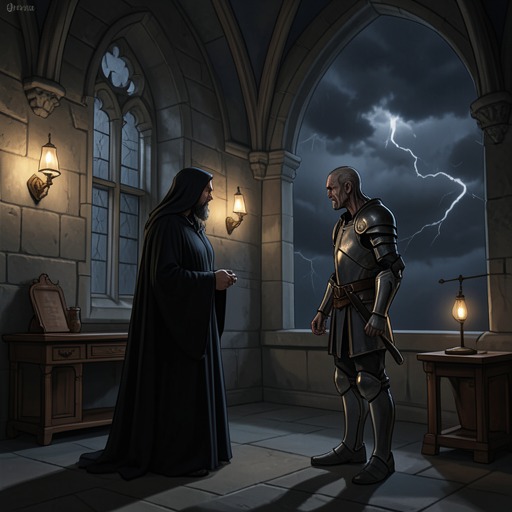
Jerome rejects Manfred’s request to assist him. He identifies the proposal to repudiate Hippolita and marry Isabella as sinful, stresses that the Church will not permit a marriage founded on lust or political calculation, and refuses to betray Hippolita’s confidence. His opposition is at once pastoral and institutional: he defends the Princess and asserts that the ruler cannot set aside religious authority to serve his succession plans.
When Manfred recasts his wish for divorce as a question of conscience, Jerome does not simply pronounce the marriage valid or invalid. He directs the Prince to submit his doubts to the Church, which alone can examine them and determine whether he may lawfully be released from the union. This response leaves open the possibility of a legitimate ruling while refusing to let Manfred treat his own convenience as that ruling. Jerome also hints that any lawful means of continuing the lineage would depend on the Church’s examination and Isabella’s consent.
Manfred takes Jerome’s apparent willingness to consider the matter as encouragement, but the priest has not agreed to advance his plan. He intends instead to delay him and frustrate the proposed marriage. The episode distinguishes formal recourse to ecclesiastical judgment from the Prince’s attempt to use religious language as cover for a decision already made.
Marriage Law in the Succession Crisis
The question of lawful marriage becomes entangled with the rival claims to Otranto. When Frederic’s herald arrives, he calls Manfred a usurper and demands both Isabella’s return and the principality’s surrender. The herald argues that Frederic is the nearest blood relative to Alfonso the Good. Manfred knows the claim is well founded, and his original arrangement for Conrad and Isabella had been intended to unite the claims of the two houses. After Conrad’s death, he had turned to marrying Isabella himself; now he hopes to secure Frederic’s consent through a proposed marriage alliance.
Hippolita, persuaded by the portents of the preceding days that the sceptre will pass from Manfred to Frederic, proposes that Matilda marry Frederic as a way to avert the destruction of the rival houses. Manfred approves, and Frederic is receptive because he is attracted to Matilda and sees a possible path to the principality. He makes his agreement conditional, at least outwardly, on Hippolita consenting to a divorce. The proposed double marriage therefore brings together dynastic strategy and the Church’s jurisdiction over the separation that Manfred requires.
Jerome refuses to treat Hippolita’s acquiescence as a private formality. When she asks his advice, he warns her that consenting to the divorce would be sinful and instructs her to reject the proposal. Later, at the altar, he publicly challenges Manfred’s plans and declares that the Church’s authority will not yield to princely threats. The dispute makes clear that political agreement among rulers cannot by itself establish the religious legitimacy of a marriage or dissolve an existing one.
Judgment and Consequences
The novel’s ending confirms the limits of Manfred’s effort to control succession through marriage. After Alfonso’s apparition identifies Theodore as the true heir, Manfred confesses that his grandfather Ricardo poisoned Alfonso and used a fictitious will to claim the principality. He recognizes that his family’s rule was founded on usurpation and relinquishes Otranto. The supernatural declaration resolves the political dispute through divine authority rather than through the marriage arrangements Manfred has tried to negotiate.
Manfred’s intended divorce and marriage do not provide the security he sought. His claim that an heir is necessary to preserve his house is overtaken by the revelation of Theodore’s rightful inheritance, and the family’s fate is not repaired by a strategic union. The Church’s resistance to his scheme belongs to the same moral structure as the final judgment: political expediency cannot make an unlawful purpose legitimate, and dynastic power remains answerable to a higher order.
The conclusion also separates lawful succession from the proposed marriages. Manfred abdicates, and he and Hippolita enter religious life. Frederic later offers Isabella to Theodore, but Theodore, still grieving Matilda, does not accept the proposal immediately. His eventual attachment to Isabella follows later conversations about Matilda rather than Manfred’s earlier attempt to make her a means of producing an heir. Marriage law thus frames both the coercive dynastic calculations that fail and the changed circumstances under which a future union becomes possible.